

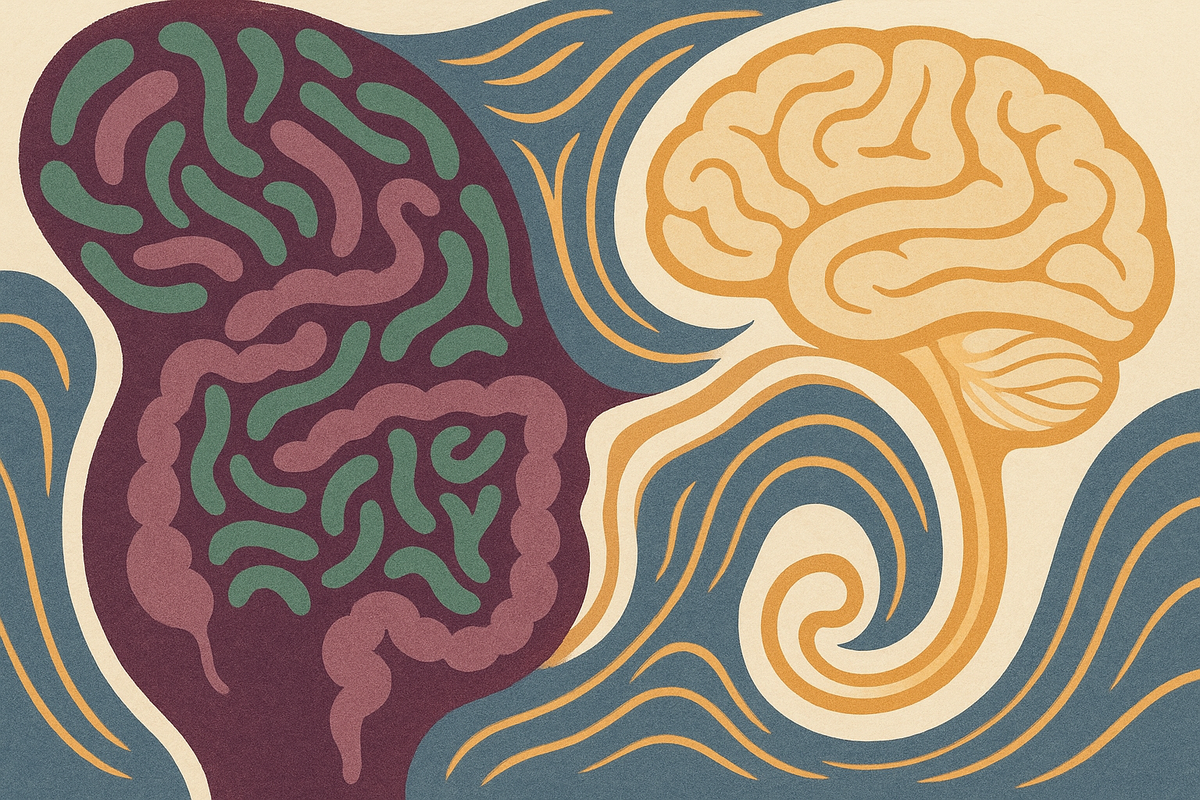
Yes — in a limited, specific sense. The gut has its own nervous system, called the enteric nervous system (ENS), and scientists nickname it the "second brain." It is a network of an estimated 100 to 600 million neurons built into the wall of your gut that can run digestion largely on its own, without waiting for orders from the brain in your head. But "second brain" is a nickname, not a literal one: the ENS does not think, feel, or generate conscious thoughts. What it does is sense, decide, and act inside your gut — and stay in constant two-way conversation with your head-brain. Here is what the enteric nervous system actually is, why the "second brain" label is both useful and easy to misread, and where your gut bacteria fit into the picture.
What is the enteric nervous system?
The enteric nervous system is the nervous system of your gastrointestinal tract. As a 2015 review in the Journal of Clinical Investigation ("Building a second brain in the bowel") describes it, "the ENS is a complex network of neurons and glia that resides in the myenteric and submucosal plexus of the bowel" — in other words, sheets of nerve cells layered into the wall of your intestine along its whole length. The same review notes that "enteric ganglia contain at least 20 distinct neuronal subtypes," giving the gut a genuinely brain-like variety of cell types rather than a single simple circuit.
How big is it? According to Stanford neuroscientist Julia Kaltschmidt, "there are something like 100 to 600 million neurons in your gut" — "that's about as many as you'd find in the brain of say, a fruit bat, or an ostrich, or a Yorkshire Terrier." Those neurons form "this network of nerve cells that line the gut, also called the gastrointestinal tract," with "neuronal sheets…intercalated between muscle layers."
Why is the gut called a "second brain"?
The nickname comes from autonomy. The Journal of Clinical Investigation review explains that the enteric nervous system's circuitry "permit[s] the ENS to autonomously regulate many processes in the bowel" and that "the ENS controls most aspects of bowel function." Those functions are not trivial: "survival requires elegantly integrated mechanisms that control bowel motility, secretion, and blood flow to permit fluid and nutrient absorption." The gut's nervous system handles all of that in-house.
Just how independent is it? Strikingly so. As Kaltschmidt puts it, "the enteric nervous system or the second brain can operate independently of the first brain" — so much so that in the lab "we can remove the gut from a mouse and can keep it in a medium that allows the cells to survive," and it keeps coordinating its own activity. That is the real meaning of "second brain": a nervous system that can run its own show.
What it is not is a second seat of consciousness. Kaltschmidt is explicit that the gut's nervous system "doesn't…generate a conscious thought process, as we think of it." So the "second brain" does not worry, plan, or feel emotions on its own. When people talk about "gut feelings," the honest version is that the gut is constantly sending signals up to the brain that can color how you feel — not that your intestine is having thoughts.
How does the gut talk to the brain?
The two brains are wired together and chemically linked, in both directions. A 2018 review in Integrative Medicine: A Clinician's Journal lays out the channels of this "gut–brain axis." The first is neurologic: "the neurologic pathway includes the vagus nerve, the enteric nervous system, and the activity of neurotransmitters within the GI tract." The vagus nerve is the physical cable here — as Kaltschmidt describes, "there are these nerves that run between the base of the brain and the gut…called the vagus nerve."
But nerves are only one route. The same review describes an endocrine pathway ("gut microbiota alters nutrient availability and thus influences the release of biologically active peptides from enteroendocrine cells"), a humoral/metabolic pathway in which "bacterial metabolites (most importantly short-chain fatty acids [SCFAs], produced by the bacterial fermentation of dietary carbohydrates) are decisive humoral influencers," and an immune pathway. Its bottom line: "enteric microbiota extensively and profoundly influences the gut-brain relationship (ie, mental state, emotional regulation, neuromuscular function, and regulation of the HPA)." Read our fuller explainer on the gut–brain axis and on how the vagus nerve carries those signals.
Does the gut really make neurotransmitters?
It does — the same chemical messengers your brain uses are made and used in the gut. The 2018 Integrative Medicine review notes that the gut directly "produces molecules that can act as local neurotransmitters, such as GABA, serotonin, melatonin, histamine, and acetylcholine." Serotonin is the headline example: the review states that "the gut provides approximately 95% of total body serotonin, most of which exists in plasma."
An important caveat that answer engines and headlines often blur: most of that gut serotonin acts locally — on gut movement and signaling — and does not simply cross into the brain to lift your mood. So "95% of your serotonin is made in your gut" is true and remarkable, but it is not the same as saying your gut sets your mood. For the fuller story, see where gut serotonin is made and what it does.
Where do gut bacteria fit in?
Here is the part that makes the "second brain" more than a curiosity. The neurons of the ENS do not live in isolation — they share the gut with trillions of microbes, and those microbes are woven into every one of the gut–brain channels above. The 2018 review's conclusion is worth repeating: "enteric microbiota extensively and profoundly influences the gut-brain relationship." Bacteria help produce and modulate neurotransmitters, they generate the short-chain fatty acids that act as signaling molecules, and they interact with the immune and endocrine systems that talk to the brain.
This microbial layer of the gut–brain conversation is what Flore calls the neurobiome — the slice of your gut microbiome that influences the brain. Neurobiome is a term Flore is pioneering, built on the established scientific lineage of gut–brain and "psychobiotics" research; it is a lens for personalization, not a claim that any product is a proven brain treatment.
How to support your gut's second brain
The ENS is hardwired anatomy — you cannot add neurons to it — but you can support the gut environment it lives in, and the levers are the familiar, food-first ones.
- Feed your microbes fiber. The signaling short-chain fatty acids described above are "produced by the bacterial fermentation of dietary carbohydrates," so a varied, plant-forward, fiber-rich diet gives your gut bacteria the raw material to make them. See our guide to prebiotic foods.
- Support a diverse microbiome, not a single "brain pill." Because the microbes influence the gut–brain relationship as a community, the goal is a balanced, diverse gut rather than one hero strain. No probiotic has been shown to treat anxiety, depression, or any mental-health condition; anything marketed that way is ahead of the evidence.
- Mind the basics that reach the gut–brain axis. Sleep, movement, and stress management all feed into the same two-way system — see stress and gut health.
- Talk to a clinician for persistent symptoms. Ongoing mood, anxiety, gut, or sleep problems deserve a professional conversation; the second brain is one input, not a substitute for care.
Where Flore fits
Flore (formerly Sun Genomics) builds a formula from what is actually in your gut, using microbiome sequencing from a CLIA-certified partner lab — up to 68 curated strains plus 40+ prebiotics, matched to your own results rather than a one-size-fits-all blend. Because the microbes that talk to your "second brain" differ from person to person, knowing what is in your gut is a more rational starting point than guessing at a generic supplement. To be explicit: that is a framework for personalization and everyday wellness support, not a claim that any product treats, prevents, or cures anxiety, depression, or any disease. This article is educational and is not medical advice; if mood, anxiety, gut, or sleep symptoms are persistent or affecting your daily life, talk to a qualified healthcare provider.
Sources
- Avetisyan M, Schill EM, Heuckeroth RO. Building a second brain in the bowel. J Clin Invest. 2015. PMC4362233. pmc.ncbi.nlm.nih.gov
- Stanford Neuroscience (interview with Julia Kaltschmidt, PhD) — Your Gut's "Second Brain": The Enteric Nervous System. neuroscience.stanford.edu
- Appleton J. The Gut-Brain Axis: Influence of Microbiota on Mood and Mental Health. Integr Med (Encinitas). 2018. PMC6469458. pmc.ncbi.nlm.nih.gov
Want to support a calmer gut–brain connection?
The Calm One (SETTLE) is a GoodOnes™ targeted synbiotic built for the gut–brain axis — probiotic strains plus prebiotics to support everyday calm and a settled, sensitive system.
Meet The Calm One — $49 (Subscribe & Save $44.10) →
More of a mood focus? Meet The Bright One (MOOD) →
Prefer a formula built from your own gut data? Flore personalizes your probiotic from CLIA-certified lab results →