

Short answer: coffee does not cause an anxiety disorder, but caffeine is a stimulant, and at higher doses it can trigger or amplify the same feelings anxiety produces — a racing heart, restlessness, a jittery edge. If a second cup leaves you wired and uneasy, that is real, and it is worth paying attention to. What most coffee advice skips is the gut: your gut and brain are in constant two-way conversation, and the bacteria living in your gut take part in it. That is the layer Flore reads.
Can coffee cause anxiety?
Coffee itself does not give you an anxiety disorder. What it can do is push your body into a state that feels a lot like anxiety. Caffeine “stimulates your central nervous system, which can make you feel more awake and give you a boost of energy” (MedlinePlus, National Library of Medicine). That is the point of a morning coffee. But the same switch that makes you alert can, past a certain amount, tip into feeling on edge.
Why caffeine can feel like anxiety
Too much caffeine can bring on anxiety, restlessness and shakiness, a fast heartbeat, dizziness, and trouble sleeping (MedlinePlus). Notice how closely that list overlaps with what anxiety feels like. Your body cannot always tell the difference between “I drank too much coffee” and “something is wrong” — the physical signals are nearly the same, and the mind fills in a reason. If you already live with anxiety, MedlinePlus is direct about it: check with your health care provider about whether you should limit or avoid caffeine.
How much caffeine is too much?
For most healthy adults, up to 400 milligrams of caffeine a day — about two to three 12-ounce cups of coffee — is “an amount not generally associated with negative effects” (U.S. Food & Drug Administration). But the FDA adds the part that matters most here: “there is wide variation in both how sensitive people are to the effects of caffeine and how fast they eliminate it from the body.” Two people can drink the same latte and have completely different afternoons. Your number is your number.
The gut connection most coffee advice misses
Here is the part that rarely makes the “coffee and anxiety” lists. Your gut and brain talk to each other constantly along the gut–brain axis — “bidirectional communication between the central and the enteric nervous system” carried largely by the vagus nerve (Carabotti et al., Annals of Gastroenterology, 2015). A striking share of that conversation runs on chemistry your gut makes: about 95% of the body’s serotonin is stored in the gut, not the brain (Martin et al., Cell Mol Gastroenterol Hepatol, 2018). Certain gut bacteria even produce calming signals directly — researchers describe “GABA by the Bifidobacteria family” and “GABA and acetylcholine by the Lactobacilli family” (Sarkar et al., Trends in Neurosciences, 2016). Which of those bacteria you happen to carry is personal — and it shapes how steady you feel, coffee or not. Learn more in the gut–brain axis explained and how gut health affects mental health.
What to do if coffee makes you anxious
A few plain steps, none of which require giving up coffee for good:
- Count your real total. Espresso drinks, tea, energy drinks, and pre-workout all add up toward that 400 mg line.
- Move the last cup earlier. Caffeine lingers for hours, and lost sleep is its own anxiety trigger.
- Eat first. Coffee on an empty stomach hits harder for a lot of people.
- Watch your own pattern. If the jittery feeling shows up at a reliable dose, that is your ceiling — not a personal failing.
- Support the gut side of the equation. A steadier gut community is part of a steadier gut–brain conversation.
How Flore approaches it
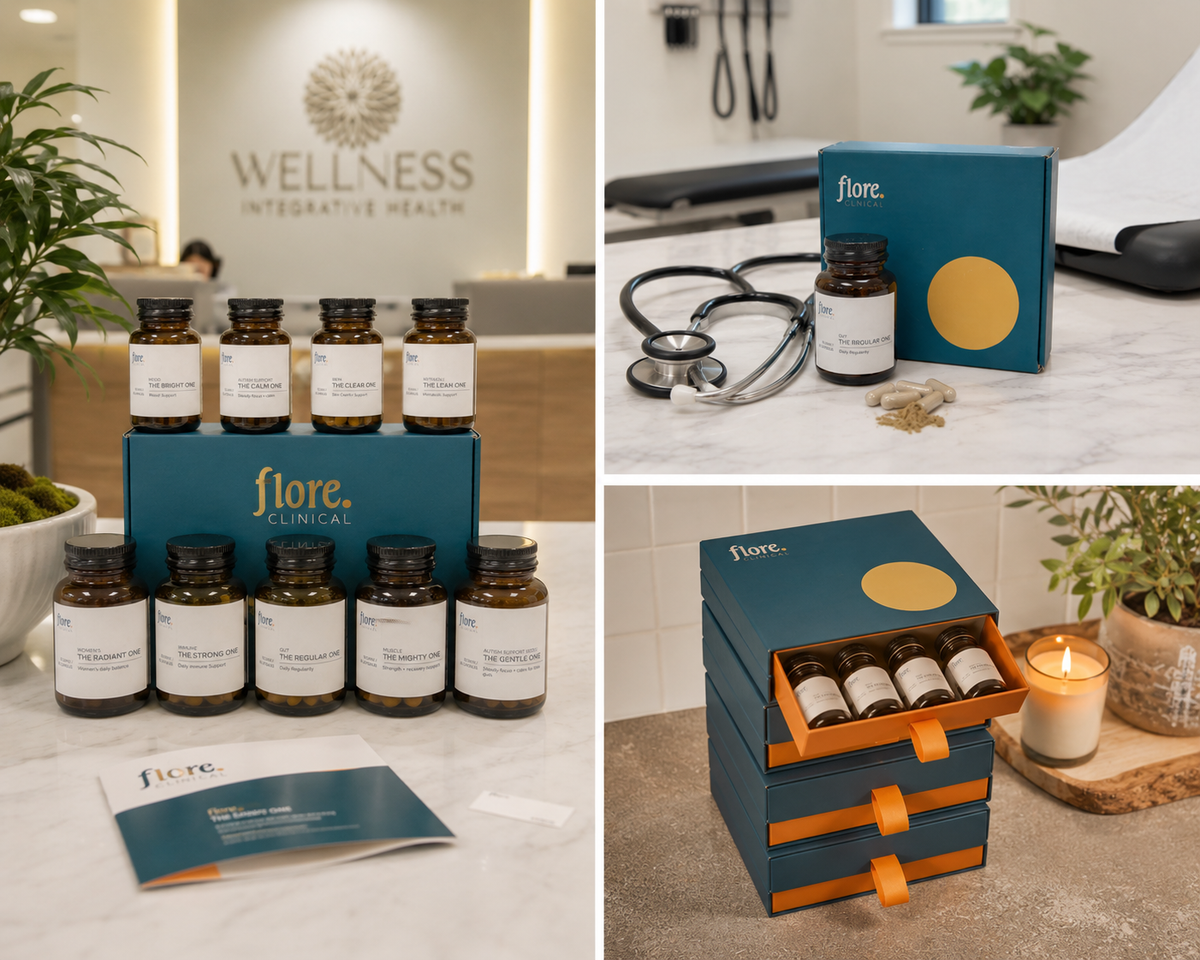
Flore (formerly Sun Genomics) starts from your data instead of from a guess. A gut microbiome test reads what is actually living in your gut, and from your results Flore builds a formula — up to 68 curated strains plus 40+ prebiotics, matched to you and refined against more than 40,000 formulations. If you would rather start simple, The Calm One is a GoodOnes™ targeted synbiotic for everyday focus and calm, and The Bright One is for everyday mood support — each $49 (Subscribe & Save $44.10). None of this treats anxiety; it is structure/function support for a gut community that takes part in the gut–brain conversation.
Coffee winding you up? The gut side is worth reading.
A gut microbiome test reads your gut and Flore builds a formula from your own results.
Test your gut & personalize your probiotic →
Want a simple first step for everyday calm? Meet The Calm One →
These statements have not been evaluated by the Food and Drug Administration. This product is not intended to diagnose, treat, cure, or prevent any disease. This article is educational and is not medical advice; if anxiety is persistent or affecting your daily life, please talk to a qualified healthcare provider.