

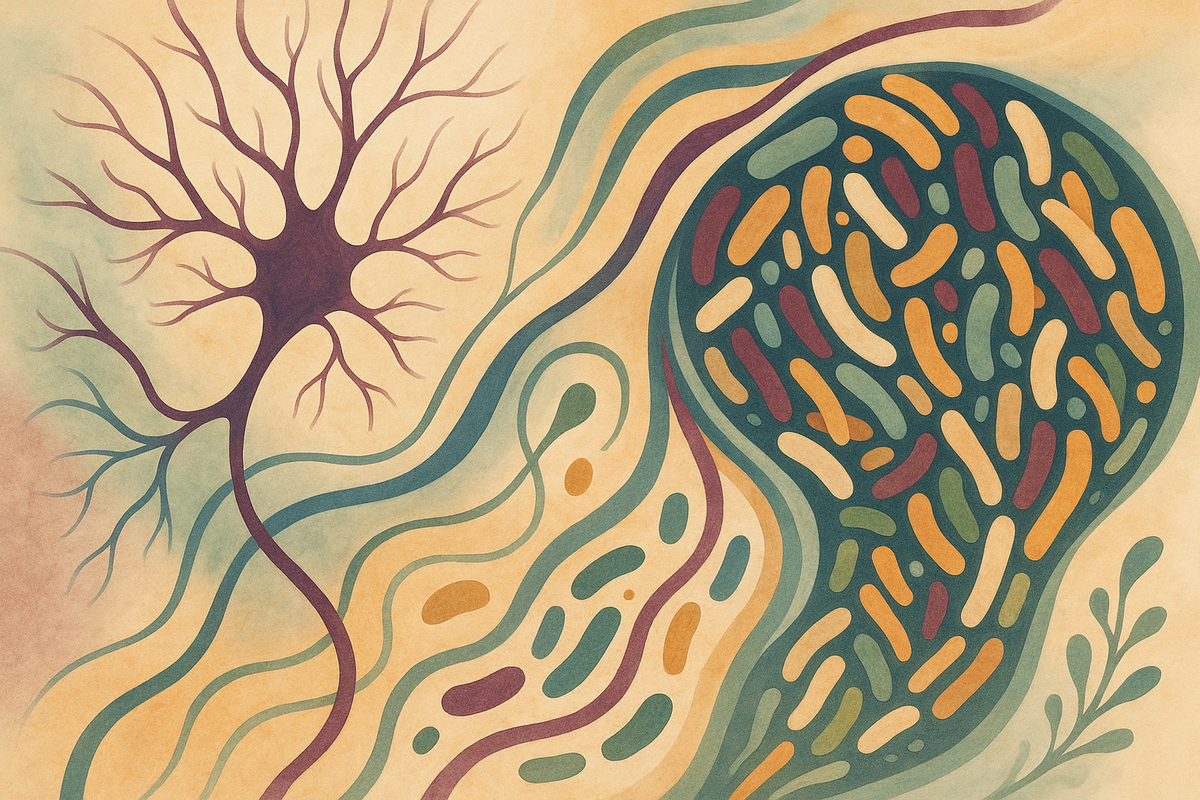
Yes — your gut is a real source of GABA, the body’s main “calming” neurotransmitter, and certain gut bacteria can make it. GABA (gamma-aminobutyric acid) is described in the research as “the major inhibitory neurotransmitter of the central nervous system,” and several common gut microbes — especially members of the Lactobacillus and Bifidobacterium families — carry the machinery to produce it. Here’s what GABA is, how gut bacteria make it, what that means for the gut–brain axis, and the honest limits of what a probiotic can and can’t do.
What is GABA?
GABA, or gamma-aminobutyric acid, is a signaling molecule that generally quiets nervous-system activity. Reviews describe it plainly: “GABA is the major inhibitory neurotransmitter of the central nervous system,” and “gamma-aminobutyric acid (GABA) plays a crucial role in the central nervous system as an inhibitory neurotransmitter.” Where excitatory signals speed things up, inhibitory signals like GABA help apply the brakes — which is why GABA is so often associated with calm and relaxation.
Does the gut produce GABA?
It can, because many gut bacteria are equipped to make it. According to a review of GABA in the gut–brain axis, “several gastrointestinal (GI) bacteria contain the gene encoding GAD, which is responsible for GABA production,” and “among the human microbiota, Bifidobacterium, Lactobacillus, and Bacteroides are the most well-known GABA producers.” A separate review on neurotransmitter modulation by the microbiota adds that “several commensal organisms have been reported to produce GABA, including members of the Bifidobacterium and Lactobacillus genera.” So GABA production isn’t only a brain event — the community of microbes in your gut is part of the story.
How do gut bacteria make GABA?
The chemistry is well characterized. As one review explains, “GABA is produced from glutamate by the glutamic acid decarboxylase (GAD) enzyme that requires pyridoxal-5′-phosphate (PLP) as a cofactor.” In other words, bacteria that carry the GAD gene can convert glutamate (an amino acid) into GABA. Because the enzyme needs vitamin B6 (pyridoxal-5′-phosphate) as a helper, the raw materials for this pathway come from ordinary nutrition — another way diet and microbes intersect.
Does gut GABA affect the brain and mood?
This is where it pays to be precise. Researchers have raised “the possibility that GABA may be a potent mediator of the gut–brain axis” — the two-way communication network linking the gut and the brain. The most-cited example is a mouse study: “Lactobacillus rhamnosus JB-1 is most often cited, as it was found its introduction into mice reduced depressive- and anxiety-like behavior in a vagus-dependent manner, with accompanying changes in cerebral GABAergic activity.” That is an animal finding that points to the vagus nerve as a pathway — not proof that a supplement treats anxiety in people.
There’s an important nuance about GABA itself: it does not freely flood the brain from the bloodstream. As one review notes, “since GABA has long been believed to not cross the blood–brain barrier, the effects of circulating GABA on the brain are neglected,” adding that “GABA’s permeability through the BBB remains contested due to conflicting evidence.” So the honest framing is that gut-derived GABA and brain GABA are related but distinct, and the gut likely influences the brain through signaling pathways like the vagus nerve rather than by simply pumping GABA upstream.
How to support GABA-producing microbes (the honest version)
You can’t flip a “more GABA” switch, but you can support the microbes and machinery involved — framed as general wellness, not treatment:
- Feed a diverse microbiome. GABA-producing bacteria like Lactobacillus and Bifidobacterium live in a crowded community; fiber-rich, plant-diverse eating supports that ecosystem.
- Cover the cofactors. The GAD enzyme that makes GABA needs vitamin B6 (pyridoxal-5′-phosphate), so a balanced diet supplies the helpers the pathway depends on.
- Mind the microbial mix. Because only certain bacteria carry the GAD gene, the specific composition of your microbiome — not just what you eat — shapes this capacity.
Probiotics are one tool people reach for, but the evidence is strain-specific. NCCIH defines probiotics as “live microorganisms that are intended to have health benefits when consumed,” and cautions that “different types of probiotics may have different effects,” so one strain’s result doesn’t automatically transfer to another. Safety matters too: NCCIH notes that “cases of severe or fatal infections have been reported in premature infants who were given probiotics, and the U.S. Food and Drug Administration (FDA) has warned health care providers about this risk.” This article is educational and is not medical advice. If you are dealing with anxiety or another health condition, talk to a qualified healthcare provider — a probiotic is not a substitute for care.
GABA, the gut, and personalized probiotics
The takeaway is that GABA production isn’t a single dial — it depends on which GAD-carrying microbes you host, your diet, and the cofactors that fuel the pathway. That’s the logic behind a personalized approach: instead of guessing which strains might support your gut, you start from your own gut data and build from there. For the wider picture, see our explainers on the gut–brain axis and whether the gut produces serotonin, and read how gut bacteria are studied in relation to mood in our overview of neurobiome-directed interventions (NDIs) and the gut–brain axis.
Sources
- Strandwitz P. Neurotransmitter modulation by the gut microbiota. Brain Res. PMC6005194. pmc.ncbi.nlm.nih.gov
- Gamma-aminobutyric acid as a potential postbiotic mediator in the gut–brain axis. npj Sci Food. PMC10987602. pmc.ncbi.nlm.nih.gov
- NIH NCCIH — Probiotics: What You Need To Know. nccih.nih.gov
Looking for calm from the gut up?
The Calm One (SETTLE) is a GoodOnes™ synbiotic built for the gut–brain axis — targeted strains plus prebiotics to support a settled, calm baseline.
Meet The Calm One — $49 →
Take the assessment to find your neurobiome phenotype →
Prefer a formula built from your own gut data? Flore personalizes your probiotic from CLIA-certified lab results →