

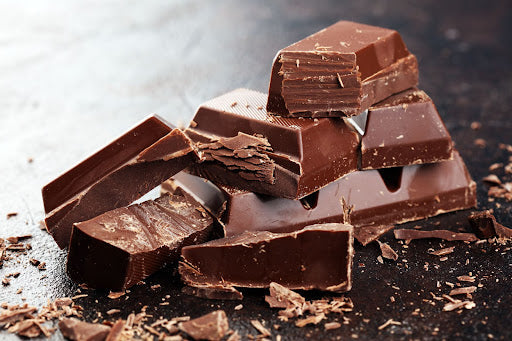
Does dark chocolate help constipation? A little, for some people, and mostly because of its fiber. One ounce (28 g) of 70–85% dark chocolate has about 3 grams of fiber, according to USDA data. That's roughly a tenth of what most adults need in a day. It's a modest nudge, not a fix, and plenty of people swear chocolate does the opposite. Here's what the research actually shows, and what does more for staying regular.
Does dark chocolate make you poop?
It can, in a small way. The fiber in cocoa adds bulk, and fiber works best with enough fluid. NIDDK, part of the National Institutes of Health, recommends 22 to 34 grams of fiber a day for adults, depending on age and sex, and plenty of liquids to help that fiber soften stools. An ounce of dark chocolate covers about 3 of those grams.
The catch is everything that comes with the fiber. That same ounce carries about 170 calories, 12 grams of fat and 7 grams of sugar (USDA FoodData Central). You'd have to eat a lot of chocolate to get a meaningful amount of fiber, and at that point the trade-off stops making sense. Fruits, vegetables, whole grains and legumes get you there with far less baggage.
Can chocolate cause constipation?
A lot of people think so. In a German survey of 200 healthy adults, 122 people with chronic constipation and 766 people with IBS-C, chocolate was the food named most often as constipating. When asked directly, 48–64% of respondents in each group said chocolate hardened their stools.
Keep in mind what that study measured: what people believe happens, not stool changes tracked in a lab. Still, if chocolate seems to back you up, trust your own pattern. Bodies differ.
What does the research say about cocoa and constipation?
The closest thing to a direct test used cocoa husk, the fiber-rich outer shell of the bean, not chocolate. In a small randomized, double-blind trial in Spain, 48 children aged 3 to 10 with chronic constipation took a cocoa husk fiber supplement or a placebo for 4 weeks. Overall transit time only trended faster. Children who started with the slowest transit saw a clearer change, and fewer children in the cocoa husk group reported hard stools by the end (41.7% vs 75.0%).
That's interesting, but it's a pilot study of a fiber supplement in kids, so it doesn't tell you a chocolate bar will do the same for an adult. If your child is constipated, talk to their pediatrician before trying any supplement.
Is dark chocolate good for your gut?
In moderation, it looks like a reasonable choice for most people. Most cocoa flavanols (a type of polyphenol) aren't absorbed in the small intestine, so they travel on to the colon, where your gut bacteria can use them.
In a randomized, double-blind crossover study, 22 healthy adults drank a high-flavanol cocoa drink (494 mg of flavanols a day) or a low-flavanol version for 4 weeks each. The high-flavanol drink raised Bifidobacteria and Lactobacilli and lowered clostridia counts compared with the low-flavanol drink. That was a purpose-made cocoa drink, though, not a candy bar, and most chocolate won't deliver flavanols at that level.
If you want the bigger picture on feeding your gut bacteria, see our guide to the best prebiotic foods and how prebiotics differ from probiotics.
Is dark chocolate a probiotic?
No. NIH's National Center for Complementary and Integrative Health defines probiotics as live microorganisms intended to have a health benefit. Regular dark chocolate doesn't contain live bacteria unless a maker adds them. Cocoa's fiber and flavanols act more like food for the bacteria you already have.
Dark chocolate, mood and the gut-brain connection
Here's where it gets more interesting. In a 3-week randomized trial in healthy adults aged 20 to 30, people who ate 30 g a day of 85% dark chocolate reported less negative mood than a no-chocolate group, and their stool samples showed higher gut microbial diversity. People eating 70% chocolate didn't show the same mood change. The groups were small (14 to 18 people each), so treat it as an early signal, not a settled answer.
It fits a bigger idea we care about at Flore: your gut bacteria and your brain are in constant conversation. Read more in the gut-brain axis, explained, or see what a neurobiome test looks at.
How to pick a dark chocolate that's kinder to your gut

- Go darker. The USDA figures above are for 70–85% cacao, and the mood study saw its effect at 85%, not 70%.
- Read the sugar line. Sugar is the main thing you're trading for the cocoa, so compare bars.
- Keep the portion small. The studies above used about 30 g a day, roughly an ounce.
- Watch the sweeteners. Some "sugar-free" bars swap in sweeteners that don't sit well with everyone. Here's how sweeteners affect your gut.
- Remember the caffeine. An ounce has about 22 mg of caffeine and about 225 mg of theobromine, a related compound (USDA). Worth knowing if you're sensitive or eating it late in the day.
What does more for constipation than chocolate?
The basics do most of the work. MedlinePlus suggests these self-care steps:
- Eat high-fiber foods like whole grains, fruits, vegetables and legumes, and add fiber gradually, since a sudden jump can cause bloating and gas.
- Drink plenty of liquids, especially water.
- Stay active, such as walking or swimming at least 3 or 4 times a week.
- Try to go at the same time each day, like after a meal, and don't ignore the urge.
Psyllium husk is one of the best-studied fiber options, and we've rounded up more natural stool softeners. On a GLP-1 medication? See constipation on Ozempic, Wegovy or Mounjaro. Not sure what counts as constipation? NIDDK describes it as fewer than three bowel movements a week, or stools that are hard, dry or lumpy. Our guide to the symptoms of constipation covers the signs and common causes.
When to see a doctor
NIDDK says to see a doctor right away if constipation comes with bleeding from the rectum, blood in your stool, constant belly pain, being unable to pass gas, vomiting, fever, lower back pain, or weight loss you can't explain. Also check in if self-care isn't helping.
Wondering what YOUR gut actually needs? Chocolate is a guess. Your own microbiome data isn't. Flore builds a personalized probiotic from your stool test results, sequenced by a CLIA-certified partner lab. Start with the Flore Test to Treat →
A microbiome test is wellness insight, not a diagnosis of constipation or any other condition. If you have ongoing symptoms, those are worth a conversation with your doctor.
Dark chocolate and constipation: FAQ
Does dark chocolate make you poop?
It can help a little. An ounce of 70–85% dark chocolate has about 3 grams of fiber, and fiber adds bulk to stool. That's modest next to the 22 to 34 grams adults need each day, so it won't act like a laxative.
Is dark chocolate good for constipation?
It's not a constipation fix. The fiber helps a bit, but an ounce also carries about 12 grams of fat and 7 grams of sugar. Whole-food fiber, water and movement do more.
Can chocolate cause constipation?
Many people believe it does. In a German survey, chocolate was the food people named most often as constipating, though the study measured perceptions rather than actual stool changes. If chocolate seems to back you up, eat less of it.
How much dark chocolate is good for your gut?
There's no official amount. The studies that found gut and mood changes used about 30 grams a day, roughly an ounce, of 85% dark chocolate or a purpose-made cocoa drink.
Is dark chocolate a probiotic?
No. Probiotics are live microorganisms, and regular dark chocolate doesn't contain live bacteria unless they're added. Cocoa's fiber and flavanols act more like food for the bacteria already in your gut.
When should I see a doctor about constipation?
Right away if constipation comes with rectal bleeding, blood in your stool, constant belly pain, being unable to pass gas, vomiting, fever, lower back pain or unexplained weight loss. Also see a doctor if self-care isn't helping.
Sources
- USDA FoodData Central. Chocolate, dark, 70–85% cacao solids (search FDC ID 170273; values per 100 g scaled to 28 g). fdc.nal.usda.gov
- NIDDK. Eating, Diet, & Nutrition for Constipation. niddk.nih.gov
- NIDDK. Definition & Facts for Constipation. niddk.nih.gov
- NIDDK. Symptoms & Causes of Constipation. niddk.nih.gov
- MedlinePlus. Constipation: self-care. medlineplus.gov
- Müller-Lissner SA, et al. The perceived effect of various foods and beverages on stool consistency. Eur J Gastroenterol Hepatol. 2005;17(1):109–112. PubMed 15647650
- Castillejo G, et al. A controlled, randomized, double-blind trial to evaluate the effect of a supplement of cocoa husk that is rich in dietary fiber on colonic transit in constipated pediatric patients. Pediatrics. 2006;118(3):e641–e648. PubMed 16950955
- Tzounis X, et al. Prebiotic evaluation of cocoa-derived flavanols in healthy humans by using a randomized, controlled, double-blind, crossover intervention study. Am J Clin Nutr. 2011;93(1):62–72. PubMed 21068351
- Shin JH, et al. Consumption of 85% cocoa dark chocolate improves mood in association with gut microbial changes in healthy adults: a randomized controlled trial. J Nutr Biochem. 2022;99:108854. PubMed 34530112
- NCCIH. Probiotics: Usefulness and Safety. nccih.nih.gov
This article is for education only and isn't medical advice. Talk with your healthcare provider about ongoing digestive symptoms. These statements have not been evaluated by the Food and Drug Administration. Flore products are not intended to diagnose, treat, cure, or prevent any disease.
Not sure where to start with your gut?
Ask the Flore Microbiome Concierge — a guided, personalized walkthrough of testing, your results, and a formula matched to your goals.
Talk to the Concierge →