

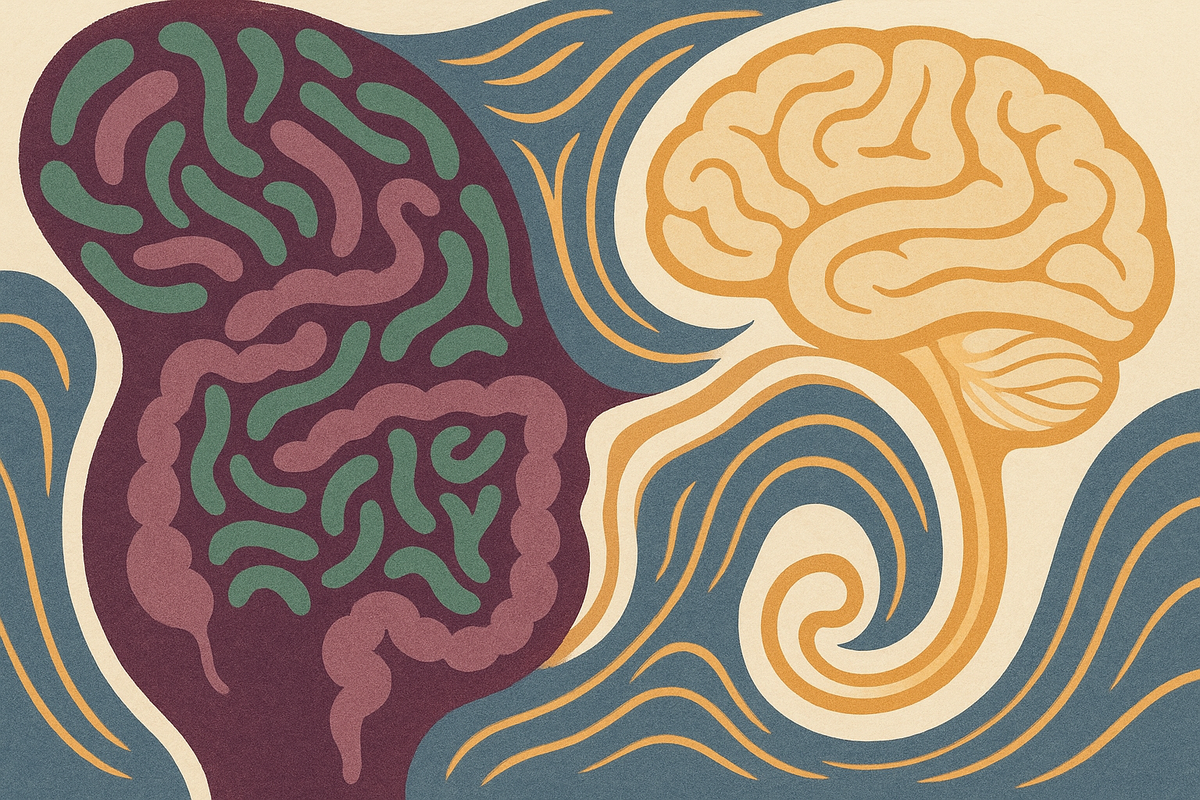
Brain fog is not a medical diagnosis. It is a plain-language description of a cluster of symptoms — trouble concentrating, losing words mid-sentence, forgetting things you just read, feeling like your thinking is running through mud. Because it is a description rather than a disease, "brain fog" has many possible causes, and the useful question is never "how do I cure brain fog?" but "what is driving mine?" Below: what researchers actually mean by the term, the causes worth ruling out first, where the gut–brain axis genuinely fits in, and an honest accounting of what a probiotic can and cannot do.
What is brain fog?
Brain fog is a symptom description, not a clinical entity — and researchers are candid about that. In a 2022 study in the Journal of Clinical Medicine that set out to characterize brain fog in 108 adults, the investigators did not even give participants a formal definition; they simply asked people to self-report yes or no as to whether they were experiencing it. In that work, brain fog covered cognitive difficulties described as "concentration issues, word-finding difficulties, memory impairment, or disorientation."
That is the honest state of the science: brain fog is real to the people who have it, it is measurable in its consequences, and it does not yet have one agreed clinical definition. It is a signal to investigate, not a diagnosis to accept.
What does brain fog feel like?
The same 2022 cross-sectional study compared 71 adults reporting brain fog against 37 who were not, and the symptom profile that separated them is a useful description of the experience. The strongest independent associations with brain fog were subjective memory impairment, fatigue, and myalgia (muscle pain). People with brain fog also reported markedly higher rates of dizziness (76% versus 38%) and word-finding difficulties (66% versus 16%), and measured lower on gait speed and grip strength.
Two things stand out. First, brain fog rarely travels alone — it clusters with fatigue and physical symptoms, which is a hint that whatever is driving it is usually systemic rather than purely "in your head." Second, the word-finding difficulty is close to a signature: reaching for a common word and coming up empty is one of the most commonly described features.
What causes brain fog?
Because brain fog is a description, the causes are wide-ranging — and some of them are medical and need a clinician, not a supplement. MedlinePlus (NIH/NLM) lists recognized causes of memory problems that include Alzheimer disease and other dementias, stroke, head injuries, brain tumours or blood clots, depression, kidney, liver or thyroid problems, and reactions to certain medicines. That list is the reason the first step for persistent, worsening, or unexplained cognitive symptoms is a healthcare provider — not a gut-health protocol.
Sleep
Sleep is the most common and most reversible contributor. The National Heart, Lung, and Blood Institute (NIH) is direct about the cognitive cost of sleep deficiency: "You might have trouble learning, focusing, and reacting." NHLBI also notes sleep deficiency makes it "hard to judge other people's emotions and reactions," and that it interferes with work, school, driving and social functioning. If you are chronically short on sleep, that alone can account for the fog.
Vitamin B12 — and why it is a gut story
MedlinePlus notes that vitamin B12 "helps in the formation of red blood cells and in the maintenance of the nervous system," and that low B12 can produce loss of balance, numbness or tingling in the arms and legs, weakness, and "dementia due to metabolic causes." The gut-relevant part is who is at risk: MedlinePlus identifies people over 50, vegetarians and vegans, those with digestive conditions, and people with pernicious anemia. B12 status depends on absorption, and absorption depends on a functioning digestive tract — which is one of the more concrete, non-hand-wavy links between the gut and how clearly you think.
Caffeine and the sleep loop
Caffeine is worth auditing because it can create the problem it is being used to solve. MedlinePlus notes that consuming too much caffeine can cause restlessness and shakiness, insomnia and anxiety, and that caffeine "reaches its peak level in your blood" within one hour with effects continuing "for four to six hours." A 2017 review in Frontiers in Psychiatry is blunter still: "Caffeine disrupts sleep in all populations studied," and notes that caffeine-driven sleep problems can lead people to consume more caffeine for daytime alertness. Combine that with NHLBI's point about sleep and focus and you have a self-reinforcing fog loop.
Can bad gut health cause brain fog?
Here is where we have to be careful, because this is exactly the claim the wellness internet overstates. There is genuine, well-replicated science showing the gut communicates with the brain. There is not evidence that a probiotic clears brain fog. Both statements are true at once.
What is well established is the machinery. A 2018 review in Integrative Medicine: A Clinician's Journal describes four routes by which gut microbes reach the brain: neurologic (the vagus nerve and enteric nervous system, which produce neurotransmitters including GABA and serotonin), endocrine, humoral/metabolic (bacterial metabolites, especially short-chain fatty acids, which cross the blood–brain barrier), and immune (cytokine production during dysbiosis). The review concludes that "enteric microbiota extensively and profoundly influences the gut-brain relationship."
Short-chain fatty acids: the clearest mechanism
The best-characterized of those routes runs on short-chain fatty acids (SCFAs). As a 2020 review in Frontiers in Endocrinology explains, "SCFAs acetate, propionate, and butyrate are the main metabolites produced in the colon by bacterial fermentation of dietary fibers and resistant starch" — on the order of "500–600 mmol of SCFAs are produced in the gut per day depending on the fiber content in the diet." Those molecules can "cross the blood-brain barrier (BBB) via monocarboxylate transporters."
They also appear to help maintain the barrier itself. A 2023 review in Cells on BBB protection by microbiota-derived SCFAs summarizes germ-free animal work in which mice raised without gut microbes showed compromised blood–brain barrier integrity, and where transplanting normal gut microbiota, giving Clostridium butyricum, or giving sodium butyrate alone reversed the loss of the tight-junction proteins occludin and claudin-5. The authors conclude that "among microbiota-derived SCFAs, butyrate seems to be the most important in the preservation of the barrier integrity."
Read that carefully: it is animal work about barrier biology, not a human trial about mental clarity. It tells you the gut–brain channel is real and that fiber-fed microbes are a meaningful input to it. It does not tell you a capsule fixes fog.
Do probiotics help brain fog? The honest answer
No probiotic has been shown to treat brain fog, and any product promising that is ahead of the evidence. The closest relevant research is on cognitive function in clinical populations. A 2025 systematic review and meta-analysis in BMC Complementary Medicine and Therapies pooled 34 randomized clinical trials covering 2,390 participants and found modest improvements on cognitive scales at 12 weeks. But the authors rated the certainty of evidence as very low to low across all outcomes, flagged substantial heterogeneity in strains, doses and assessment tools, noted high-risk-of-bias concerns in 29% of studies, and concluded plainly: "Although probiotics show potential benefits, the current evidence remains highly uncertain, warranting further rigorous trials."
Two caveats matter for anyone reading that as a reason to buy something. Those trials were largely conducted in people with diagnosed cognitive impairment, not healthy adults with everyday fog. And "very low to low certainty" is the scientific way of saying the result may not survive better studies. Probiotics are not a treatment for brain fog, cognitive impairment, or any medical condition.
How to get rid of brain fog: a sensible order of operations
- Rule out the medical causes first. Persistent, worsening, or unexplained cognitive symptoms warrant a clinician. MedlinePlus lists thyroid, kidney and liver problems, depression, medication reactions, head injury and neurological disease among recognized causes of memory problems — several are straightforward to test for and treatable.
- Fix sleep before anything else. It is the highest-yield, lowest-cost lever, and NHLBI is explicit that sleep deficiency impairs learning, focusing and reacting.
- Audit your caffeine. MedlinePlus notes up to 400 mg a day is not harmful for most people, but a single 8-ounce cup of coffee can carry 95–200 mg. If caffeine is landing within six hours of bed, it is buying today's alertness with tomorrow's.
- Feed the fiber-fermenting microbes. SCFAs come from bacterial fermentation of dietary fiber and resistant starch, and daily SCFA output tracks the fiber content of the diet. This is a food-first move — see our guides to prebiotic foods and resistant starch.
- Then, if you want to go further, start from data rather than guesswork. Because effects in the probiotic literature are strain-specific and the composition of each person's microbiome differs, knowing what is actually in your gut is a more rational starting point than picking a strain off a shelf.
Where Flore fits
Flore (formerly Sun Genomics) builds a formula from what is actually in your gut, using microbiome sequencing from a CLIA-certified partner lab — up to 68 curated strains plus 40+ prebiotics, matched to your own results rather than a one-size-fits-all blend. We call the gut–brain slice of that ecosystem the neurobiome, and the targeted formulations built for it neurobiome-directed interventions (NDIs) — terms Flore is pioneering, building on the established scientific lineage of psychobiotics research. To be explicit: that is a framework for personalization, not a claim that any product treats brain fog or any cognitive condition.
For the wider picture, see the gut–brain axis explained, gut health and sleep, and does gut health affect cortisol. This article is educational and is not medical advice; if brain fog is persistent, worsening, or affecting your daily life, talk to a qualified healthcare provider.
Sources
- Jennings G, et al. Comprehensive Clinical Characterisation of Brain Fog in Adults Reporting Long COVID Symptoms. J Clin Med. 2022. PMC9224578. pmc.ncbi.nlm.nih.gov
- MedlinePlus (NIH/NLM) — Memory. medlineplus.gov/memory.html
- MedlinePlus (NIH/NLM) — Vitamin B12. medlineplus.gov
- MedlinePlus (NIH/NLM) — Caffeine. medlineplus.gov/caffeine.html
- NHLBI (NIH) — Sleep Deprivation and Deficiency. nhlbi.nih.gov
- Temple JL, et al. The Safety of Ingested Caffeine: A Comprehensive Review. Front Psychiatry. 2017. PMC5445139. pmc.ncbi.nlm.nih.gov
- Appleton J. The Gut-Brain Axis: Influence of Microbiota on Mood and Mental Health. Integr Med (Encinitas). 2018. PMC6469458. pmc.ncbi.nlm.nih.gov
- Silva YP, et al. The Role of Short-Chain Fatty Acids From Gut Microbiota in Gut-Brain Communication. Front Endocrinol. 2020. PMC7005631. pmc.ncbi.nlm.nih.gov
- Fock E, Parnova R. Mechanisms of Blood–Brain Barrier Protection by Microbiota-Derived Short-Chain Fatty Acids. Cells. 2023. PMC9954192. pmc.ncbi.nlm.nih.gov
- Calzada-Gonzales N, et al. Efficacy and safety of probiotic supplements on cognitive function: a systematic review and meta-analysis of randomized clinical trials. BMC Complement Med Ther. 2025. PMC12645680. pmc.ncbi.nlm.nih.gov
Want to support mental clarity from the gut up?
The Bright One (MOOD) is a GoodOnes™ targeted synbiotic built for the gut–brain axis — probiotic strains plus prebiotics to support mood and everyday mental clarity.
Meet The Bright One — $49 (Subscribe & Save $44.10) →
Prefer a formula built from your own gut data? Flore personalizes your probiotic from CLIA-certified lab results →