

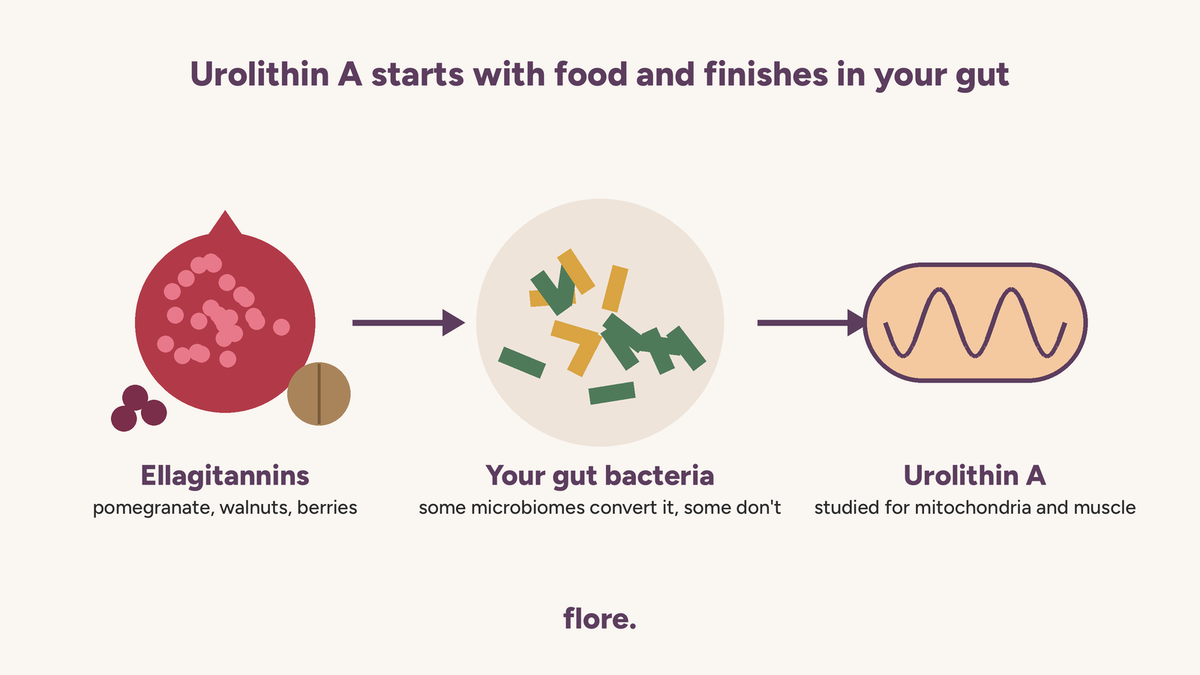
Urolithin A is a compound your gut bacteria make from ellagitannins, the plant polyphenols in pomegranate, walnuts and some berries. Human trials have studied it for mitochondria and muscle in older and middle-aged adults. No published trial has yet given urolithin A by itself to women in menopause and measured menopause outcomes. The most useful thing to know: whether you make urolithin A at all depends on your microbiome, and many people make little or none. Here is what urolithin A is, what the research shows, what it doesn't, and how your own gut decides the answer.
What is urolithin A?
You don't eat urolithin A directly. You eat ellagitannins and ellagic acid, found in pomegranate, walnuts, and berries like raspberries and blackberries. Bacteria in your colon then convert them, step by step, into urolithins. Urolithin A is the best studied of the group.
The food supplies the raw material. Your bacteria do the work. That second step is where people differ.
Why your gut decides whether you make it
Researchers sort people into three urolithin "metabotypes," based on what shows up after they eat ellagitannin foods:
- Metabotype A: makes mostly urolithin A.
- Metabotype B: makes a different mix, including urolithin B and isourolithin A.
- Metabotype 0: makes little to no urolithins at all.
How common is each? In one trial of 100 healthy adults, only 12% had detectable urolithin A at the start. After a glass of pomegranate juice, about 40% converted a meaningful amount. The producers had more diverse gut bacteria than the non-producers. (That study was funded by a company that sells urolithin A.)
Age matters too. A study of 839 people aged 5 to 90 found that aging was the main factor shaping which metabotype a person had. For women in midlife, that's worth knowing: the gut you have at 50 may not convert these foods the way it did at 25.
So two women can eat the same bowl of pomegranate seeds and end up in different places. One makes urolithin A. The other mostly doesn't.
What the human research shows
Most urolithin A trials used a purified supplement dose, not food, and were sponsored by the company that makes it. Here is the honest read.
- First-in-human trial (2019). In healthy, sedentary older adults, urolithin A had a favorable safety profile, reached the bloodstream at every dose tested, and after 4 weeks at 500 mg or 1,000 mg changed markers of mitochondrial activity in muscle.
- Older adults, 65 to 90 (2022). 66 people took 1,000 mg a day or placebo for 4 months. About 76% were women, average age near 72. Urolithin A improved muscle endurance in a hand and a leg muscle, and lowered several blood markers including C-reactive protein. The two main goals, 6-minute walk distance and peak energy production in muscle, did not improve significantly versus placebo.
- Middle-aged adults (2022). Four months of urolithin A improved muscle strength by about 12%. The study's primary goal, peak power output, did not improve significantly.
- The big-picture review (2026). A meta-analysis pooled five small randomized trials (236 people). The walking result leaned positive but was not statistically conclusive, and certainty was rated low. The authors called the other findings early signals and asked for larger, longer trials.
Most people in the older-adult trial were women in their 60s, 70s and 80s. It was not a menopause study, though, and its published abstract doesn't break results out by sex or menopause status.
What's actually been studied in menopause
The closest work is a Spanish trial in non-medicated postmenopausal women. It tested a mixed polyphenol extract (pomegranate, resveratrol and red clover isoflavones), not urolithin A on its own.
- Metabotypes barely changed with menopause. Comparing 120 premenopausal and 90 postmenopausal women, the researchers found only minor differences in metabotype patterns.
- Quality of life moved in some women, not all. After 8 weeks on the extract, 78 women completed the quality-of-life portion. Meaningful gains in the menopause and health score, driven mainly by fewer hot flashes, showed up in specific metabotype groups. Every one of those groups was made up of equol producers, people whose gut converts soy and red clover isoflavones. This was not a urolithin A effect on its own.
- Blood lipids were mixed. In the same trial, total cholesterol, LDL and triglycerides went up, while oxidized LDL went down. How much it moved depended on metabotype.
The thread through all of it: the same food or extract did different things in different women, and the difference tracked with their gut bacteria.
Food sources of ellagitannins
- Pomegranate (arils and juice)
- Walnuts
- Raspberries and blackberries
These are everyday whole foods whatever your metabotype. Read more in our guide to gut-healthy fruits. Just know the urolithin A part depends on who's living in your gut.
Where Flore fits
Flore (formerly Sun Genomics) does not sell urolithin A or a pomegranate extract. We build your probiotic formula from your own gut data: up to 68 curated strains plus 40+ prebiotics, matched to your results instead of a one-size-fits-all blend.
Urolithin A is a clean example of why that matters. The same food works differently in different guts. Start from what's in yours, and every decision after that, food, supplement or formula, gets made on your data instead of a guess.
Menopause also changes how your gut handles hormones. See what the estrobolome is, gut health and hormones, and our honest guide to probiotics for women.
For clinicians: Flore Clinical covers the bacteria behind each conversion step in The Bugs That Make Urolithin A.
Talk to your clinician before adding urolithin A or any supplement, especially if you take medication, and for any menopause symptoms that affect your daily life.
Frequently asked questions
What is urolithin A?
Urolithin A is a compound your gut bacteria make from ellagitannins and ellagic acid, plant polyphenols found in pomegranate, walnuts, and berries like raspberries and blackberries. You don't eat it directly. Your colon bacteria convert those foods into urolithins, and urolithin A is the best studied of the group.
Does urolithin A help with menopause?
That hasn't been tested directly. No published trial has given urolithin A by itself to women in menopause and measured menopause outcomes. Human urolithin A trials studied mitochondria and muscle in older and middle-aged adults. The closest menopause research tested a mixed polyphenol extract with pomegranate, resveratrol and red clover in postmenopausal women, and the quality-of-life gains it found tracked with equol-producing gut bacteria, not urolithin A alone.
Can I get urolithin A from eating pomegranate?
Only if your gut bacteria can convert it. Researchers group people into urolithin metabotypes: A makes mostly urolithin A, B makes a different mix including urolithin B, and 0 makes little to none. In one trial of 100 healthy adults, about 40% converted a meaningful amount after a glass of pomegranate juice.
Does age change whether I make urolithin A?
It can. A study of 839 people aged 5 to 90 found that aging was the main factor shaping which urolithin metabotype a person had. A separate trial found only minor differences in metabotype patterns between premenopausal and postmenopausal women.
What did the urolithin A trials in older adults find?
In a 4-month trial of 66 adults aged 65 to 90, about 76% of them women, 1,000 mg a day improved muscle endurance in a hand and a leg muscle and lowered several blood markers, but the main goals, 6-minute walk distance and peak muscle energy production, did not improve significantly versus placebo. A 2026 meta-analysis of five small trials rated the evidence low certainty and called for larger, longer studies.
Does Flore sell urolithin A?
No. Flore does not sell urolithin A or a pomegranate extract. Flore builds a personalized probiotic formula from your own gut data, with up to 68 curated strains plus 40+ prebiotics. Talk to your clinician before adding urolithin A or any supplement, especially if you take medication.
Sources
- Andreux PA, et al. The mitophagy activator urolithin A is safe and induces a molecular signature of improved mitochondrial and cellular health in humans. Nat Metab. 2019. PMID 32694802. pubmed.ncbi.nlm.nih.gov
- Liu S, et al. Effect of Urolithin A Supplementation on Muscle Endurance and Mitochondrial Health in Older Adults: A Randomized Clinical Trial. JAMA Netw Open. 2022. PMID 35050355. pubmed.ncbi.nlm.nih.gov
- Singh A, et al. Urolithin A improves muscle strength, exercise performance, and biomarkers of mitochondrial health in a randomized trial in middle-aged adults. Cell Rep Med. 2022. PMID 35584623. pubmed.ncbi.nlm.nih.gov
- Dao T, et al. Effects of Urolithin A supplementation on muscle health outcomes in humans from randomized controlled trials. Front Nutr. 2026. PMID 42559151. pubmed.ncbi.nlm.nih.gov
- Singh A, et al. Direct supplementation with Urolithin A overcomes limitations of dietary exposure and gut microbiome variability in healthy adults. Eur J Clin Nutr. 2022. PMID 34117375. pubmed.ncbi.nlm.nih.gov
- Cortés-Martín A, et al. The gut microbiota urolithin metabotypes revisited: the human metabolism of ellagic acid is mainly determined by aging. Food Funct. 2018. PMID 30004553. pubmed.ncbi.nlm.nih.gov
- Selma MV, et al. The gut microbiota metabolism of pomegranate or walnut ellagitannins yields two urolithin-metabotypes. Clin Nutr. 2018. PMID 28347564. pubmed.ncbi.nlm.nih.gov
- Iglesias-Aguirre CE, et al. Gut Bacteria Involved in Ellagic Acid Metabolism To Yield Human Urolithin Metabotypes Revealed. J Agric Food Chem. 2023. PMID 36840624. pubmed.ncbi.nlm.nih.gov
- Ribeiro M, et al. Urolithin as a Metabolite of Ellagitannins and Ellagic Acid from Fruits and Nuts Produced by the Gut Microbiota. Curr Nutr Rep. 2025. PMID 40180655. pubmed.ncbi.nlm.nih.gov
- Jarrín-Orozco MP, et al. Polyphenol-Related Gut Metabotype Signatures Linked to Quality of Life in Postmenopausal Women: A Randomized, Placebo-Controlled Crossover Trial. Nutrients. 2025. PMID 41305622. pubmed.ncbi.nlm.nih.gov
- García-Nicolás M, et al. Polyphenols increase circulating lipids but improve LDL particle quality and reduce LDL oxidation in postmenopausal women. Eur J Nutr. 2026. PMID 42371155. pubmed.ncbi.nlm.nih.gov
This article is educational and is not medical advice. These statements have not been evaluated by the Food and Drug Administration. Flore products are not intended to diagnose, treat, cure, or prevent any disease.
Know what's in your gut before you decide.
Flore builds your probiotic formula from your own microbiome data.
Start with Flore →