
Scientifically reviewed by the Flore science team. Every study referenced below is cited with its primary source and linked to PubMed. Where the human evidence is early-stage, we say so — and we keep claims to what the science supports.
Lion’s mane in your coffee. Reishi in your nightcap. Turkey tail in a capsule. Functional mushrooms have gone mainstream, and most of the conversation has been about focus, calm, and immunity. But there’s a quieter story underneath all of it — one that happens lower down, in the part of you that does the most metabolic heavy lifting.
A large fraction of what makes a mushroom a mushroom never gets absorbed in your small intestine. It travels intact to your colon, where it meets the trillions of bacteria that make up your gut microbiome. And there, those mushroom compounds do something specific: they feed your bacteria.
In other words, the most interesting thing about mushrooms for gut health may be that they behave like a prebiotic. Here is what that actually means, which compounds are responsible, and what happens when they meet a microbiome that is ready to use them.
Why Mushrooms Matter for the Microbiome
Your gut microbiome is an ecosystem of roughly 30–40 trillion microbes that help digest food, train your immune system, produce vitamins, and manufacture the short-chain fatty acids (SCFAs) that keep your gut lining fed and intact. Like any ecosystem, it runs on what you put into it. Feed it well and the beneficial residents thrive; starve them and the community thins out and loses resilience.
Mushrooms are unusual in the plant-and-fungi food world because their cell walls are not built primarily from cellulose, the way plant cell walls are. They are built from fungal-specific polysaccharides — chiefly beta-glucans, along with chitin, mannans, and various polysaccharide-protein complexes. Human digestive enzymes cannot break most of these down. That is not a flaw; it is the entire point. Anything you can’t digest yourself is a candidate meal for the microbes that can.
This is the same reason fiber matters so much for gut health — and why the strains in your gut, not just the fiber on your plate, determine whether that fiber helps or just makes you bloat. We’ve written about that mismatch before in why a probiotic without a prebiotic is a plant without soil.
How a mushroom fiber becomes a gut benefit
The Mechanism: How Mushrooms Act as Prebiotics
A prebiotic has a precise definition. It is a substrate that is selectively used by host microorganisms to confer a health benefit — the consensus definition adopted by the International Scientific Association for Probiotics and Prebiotics (ISAPP) in 2017.[1] In plain terms: a prebiotic is a fermentable compound, usually a fiber or complex carbohydrate, that your beneficial gut bacteria can eat and that you largely cannot. The classic prebiotics are inulin, fructooligosaccharides (FOS), and galactooligosaccharides (GOS). Several mushroom polysaccharides meet the same criteria.
Beta-glucans: the headliner
Beta-glucans are long chains of glucose linked by beta-glycosidic bonds — the bonds human enzymes can’t cleave. The specific linkage pattern in mushrooms (often beta-1,3 with beta-1,6 branches) differs from the beta-glucans in oats and barley, but the principle is identical: they reach the colon intact and get fermented there. When researchers ferment beta-glucan-rich edible mushrooms with human gut bacteria in the lab, they see selective growth of beneficial groups and a rise in SCFA output — the signature of prebiotic activity.[2]
Chitin and chitosan
Chitin is the tough structural fiber in fungal cell walls (the same family of molecule found in insect and crustacean shells). Its partially deacetylated form, chitosan, and chitin-derived oligosaccharides are increasingly studied as fermentable substrates that certain gut bacteria can use. Like beta-glucans, they pass through the upper gut largely intact and become available to the colonic community.
Mannans and polysaccharide-protein complexes
Beyond beta-glucans and chitin, mushrooms carry mannans and complex polysaccharide-protein molecules. The best-studied of these is the polysaccharopeptide (PSP) from turkey tail (Trametes versicolor). In a small randomized trial in healthy volunteers, eight weeks of PSP produced consistent, prebiotic-like shifts in the gut microbiome.[3] In vitro work backs this up, showing PSP increasing Bifidobacterium and Lactobacillus while suppressing less desirable groups.[4]
The mushrooms people actually ask about
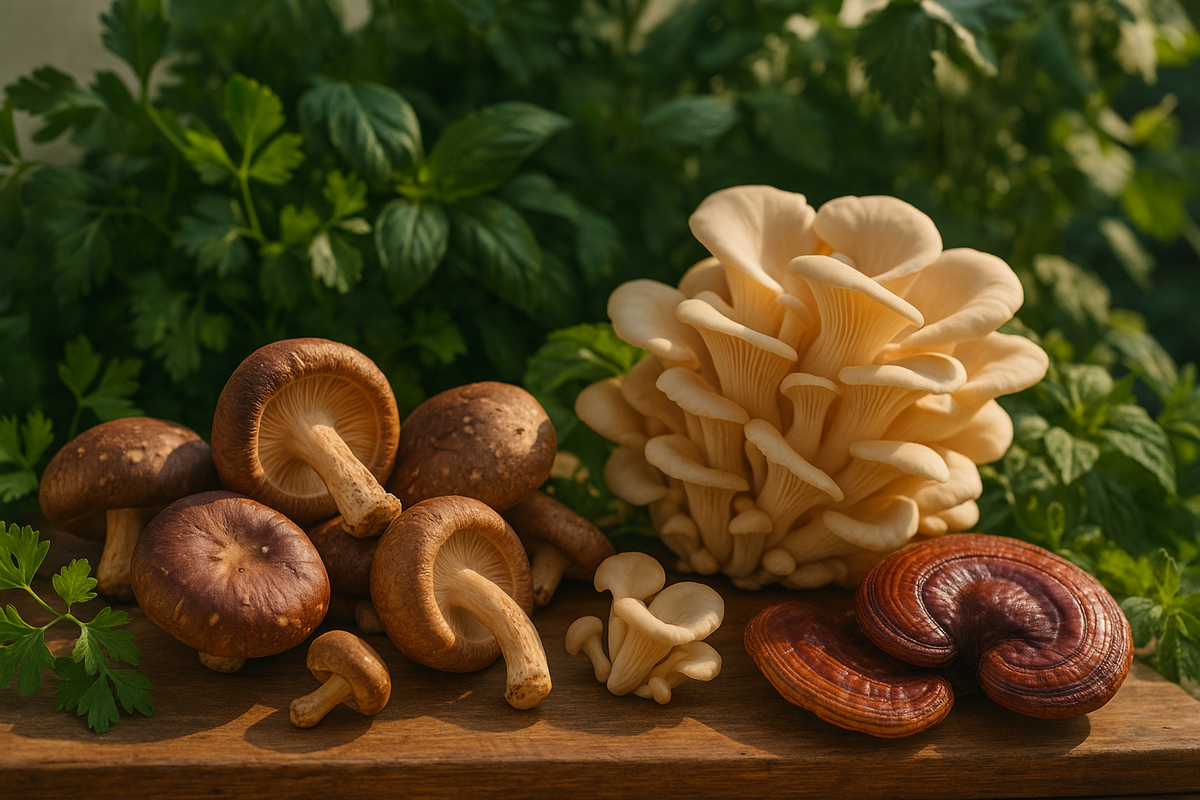
- Lion’s mane (Hericium erinaceus) — rich in beta-glucans and other polysaccharides; best known for cognitive interest, but its fiber fraction is fermentable in the colon.
- Reishi (Ganoderma lucidum) — its polysaccharides have been described in animal work as acting like a prebiotic, reshaping the gut community and the ratio of major bacterial phyla.[5]
- Turkey tail (Trametes versicolor) — the PSP source above; the strongest direct human prebiotic signal of the group.
- Shiitake and maitake (Lentinula edodes, Grifola frondosa) — both are dense in beta-glucans (lentinan and grifolan, respectively) that ferment in the colon.
A fair, honest read of the evidence: the prebiotic mechanism — mushroom polysaccharides surviving to the colon and being fermented by gut bacteria — is well established in vitro and in animals, with promising early human data (strongest for turkey tail PSP). Many downstream health claims that get attached to mushrooms are still preliminary. We’re describing how these compounds feed your microbiome, not promising they treat any condition.
At a glance: five mushrooms, their fibers, and what they feed
| Mushroom | Key prebiotic compound(s) | Observed microbiome effect | Evidence strength |
|---|---|---|---|
| Lion’s mane Hericium erinaceus |
Beta-glucans & other polysaccharides | Fermentable fiber fraction; supports SCFA output in the colon | Early |
| Reishi Ganoderma lucidum |
Beta-glucans, polysaccharide-protein complexes | Reshapes community & phylum ratios; prebiotic-like in animal work[5] | Animal |
| Turkey tail Trametes versicolor |
Polysaccharopeptide (PSP), beta-glucans | ↑ Bifidobacterium & Lactobacillus; prebiotic-like shifts in volunteers[3][4] | Human (early) |
| Shiitake Lentinula edodes |
Lentinan (beta-1,3/1,6-glucan) | Dense beta-glucan; ferments in the colon to SCFAs[2] | In vitro |
| Maitake Grifola frondosa |
Grifolan (beta-glucan) | Dense beta-glucan; fermentable colonic substrate[2] | In vitro |
“Evidence strength” describes the stage of research for the gut-microbiome (prebiotic) effect specifically — not other uses. Superscripts map to the numbered references at the foot of this article.
The Combined Effect: What Happens When Mushrooms Feed Your Gut
When fermentable mushroom polysaccharides reach a microbiome equipped to use them, a fairly predictable chain of events follows. This is the same machinery behind any good prebiotic — mushrooms simply bring their own distinctive substrates to it.
1. Short-chain fatty acid production
As bacteria ferment beta-glucans and other mushroom polysaccharides, they release SCFAs — primarily acetate, propionate, and butyrate. Butyrate is the preferred fuel for the cells lining your colon. More substrate for butyrate-producing bacteria generally means more butyrate, which is one of the most consistently observed outcomes when mushroom fibers are fermented.[2]
2. Gut barrier integrity
Because butyrate feeds the colon’s epithelial cells, a well-fed butyrate-producing community supports the integrity of the gut lining — the single-cell barrier that decides what gets into your bloodstream and what stays out. Strengthening the fuel supply to that barrier is one of the most cited reasons SCFA production matters.
3. Shifts toward beneficial bacteria
Across the fermentation studies, the recurring pattern is selective growth of Bifidobacterium and Lactobacillus, and in some work the mucin-associated Akkermansia muciniphila, often alongside relative declines in less favorable groups.[3][4][5] That is the textbook definition of prebiotic selectivity — you’re not feeding the whole ecosystem equally, you’re feeding the residents you want.
4. Microbial diversity and inflammation balance
A more diverse, SCFA-rich gut community tends to be a more resilient one, and SCFAs themselves participate in immune signaling that helps keep inflammatory tone in check. This is an area of active research rather than settled fact, so we’ll say it plainly: the prebiotic-to-SCFA-to-barrier pathway is well supported; the broader systemic effects are promising and still being mapped.
What the fermentation produces — and how solid the evidence is
The Synbiotic Angle: Prebiotic Mushrooms + the Right Probiotic Strains
Here is the catch that the wellness aisle skips over. A prebiotic only works if the bacteria that can ferment it are actually present in your gut. Mushroom beta-glucans feed butyrate producers, bifidobacteria, and lactobacilli — but if your microbiome is low in those exact residents, you can eat all the lion’s mane and turkey tail you like and get a fraction of the benefit (and sometimes more gas than payoff).
That is the logic behind a synbiotic: deliberately pairing a prebiotic with the probiotic strains that thrive on it, so the food and the eaters arrive together. We go deep on this idea on our best synbiotic 2026 page, and on why pairing beats either piece alone in a probiotic without a prebiotic is a plant without soil.
There are two practical ways to put this to work:
Build a formula from your own gut data — Flore
The most precise approach is to find out which beneficial residents you’re actually low in before you decide what to feed and seed. Flore builds a personalized probiotic formula from your microbiome data — matched against nine years of real-world outcomes from 40,000+ formulations, with up to 68 curated strains and 40+ prebiotics. If your data shows you’re short on butyrate producers or bifidobacteria, your formula can include both the strains and the prebiotic fibers that support them — the synbiotic done from the inside out. Build your formula →
Pair mushroom prebiotics with a targeted single strain — GoodOnes™
If you already lean on functional mushrooms and just want to add the matching probiotic, our GoodOnes™ sub-brand makes single-strain synbiotics that are easy to pair with your routine. Each one is “one strain, one job”:
- The Regular One — for GI regularity, a natural match for a daily beta-glucan habit.
- The Strong One — for immune resilience, pairs with reishi and turkey tail routines.
- The Calm One — focus and calm for sensitive systems, alongside lion’s mane.
- The Radiant One — for women’s microbial balance.
You can mix and match — a single is $49, a duo is $90, and a four-pack is $180. Browse all of them and build a pack on GoodOnes™, or take the two-minute quiz if you’re not sure where to start.
Synbiotic pairings: mushroom prebiotic + the matching GoodOnes™ strain
If you already have a mushroom habit, here is how to pair it. The prebiotic is the food; the GoodOnes™ single-strain synbiotic is the eater you’re reinforcing.
| Mushroom prebiotic | What it tends to feed | Pair with (GoodOnes™) | Synbiotic goal |
|---|---|---|---|
| Shiitake / maitake beta-glucans | Butyrate producers & bifidobacteria | The Regular One | GI regularity for a daily beta-glucan habit |
| Reishi & turkey tail polysaccharides | Bifidobacteria/lactobacilli linked to immune balance | The Strong One | Immune resilience to match a reishi/turkey-tail routine |
| Lion’s mane polysaccharides | Colonic fermenters feeding the gut–brain axis | The Calm One | Focus and calm for sensitive systems |
| Mixed beta-glucans (broad prebiotic base) | Lactobacilli tied to women’s microbial balance | The Radiant One | Women’s microbial balance |
These are pairing suggestions for a wellness routine, not medical advice. The most precise pairing comes from your own data — build a formula from your gut data to feed and seed the exact residents you’re low in.
Not sure which residents your gut is missing? That’s exactly what your microbiome data answers — and what a coach can help you interpret. Our microbiome coaching walks you through your results with Dr. Marina De León, PhD.
The Bottom Line
Mushrooms earn their place in a gut-health routine not because they’re trendy, but because their beta-glucans, chitin, and polysaccharide-protein complexes are genuine fermentable substrates — food for the microbes that produce butyrate, feed your gut lining, and keep the ecosystem diverse. They behave like prebiotics, and the human evidence (strongest for turkey tail PSP) is catching up to the mechanism.
The real leverage is in the pairing. A prebiotic is only as good as the bacteria available to use it. Find out which residents you’re actually low in, feed and seed those specifically, and you turn a trendy mushroom latte into something your microbiome can act on. Build your formula from your gut data →
Frequently Asked Questions
Are mushrooms really prebiotics?
Several mushroom polysaccharides — especially beta-glucans and turkey tail’s polysaccharopeptide (PSP) — meet the working definition of a prebiotic: they resist digestion in the upper gut, reach the colon intact, and are selectively fermented by beneficial bacteria, producing short-chain fatty acids. The mechanism is well established in lab and animal studies, with promising early human data.
Which mushrooms are best for gut health?
The most-studied for prebiotic activity are turkey tail (the strongest human signal), reishi, shiitake, and maitake, all dense in beta-glucans. Lion’s mane also contains fermentable polysaccharides. The best choice depends less on the mushroom and more on whether your gut has the bacteria to use it.
Do mushroom beta-glucans produce butyrate?
Yes — when gut bacteria ferment mushroom beta-glucans, short-chain fatty acids including butyrate are a typical product. Butyrate is the main fuel for the cells lining your colon, which is one reason SCFA production is a marker of a well-fed microbiome.
Should I take a probiotic with my mushroom supplement?
Pairing a prebiotic with the probiotic strains that ferment it — a synbiotic — can make both more effective, but only if you’re feeding strains your gut is actually low in. Microbiome testing tells you which residents to support; from there you can build a personalized formula with Flore or add a targeted single-strain GoodOnes™ synbiotic.
Can mushrooms treat gut conditions?
No. The evidence here is about feeding a healthy microbiome, not treating disease. Mushroom prebiotics support the ecosystem; they are not a treatment for any medical condition.
References
- Gibson GR, Hutkins R, Sanders ME, et al. Expert consensus document: The International Scientific Association for Probiotics and Prebiotics (ISAPP) consensus statement on the definition and scope of prebiotics. Nat Rev Gastroenterol Hepatol. 2017;14(8):491–502. doi:10.1038/nrgastro.2017.75. PubMed
- Mitsou EK, Saxami G, Stamoulou E, et al. Effects of Rich in β-Glucans Edible Mushrooms on Aging Gut Microbiota Characteristics: An In Vitro Study. Molecules. 2020;25(12):2806. doi:10.3390/molecules25122806. PubMed
- Pallav K, Dowd SE, Villafuerte J, et al. Effects of polysaccharopeptide from Trametes versicolor and amoxicillin on the gut microbiome of healthy volunteers: a randomized clinical trial. Gut Microbes. 2014;5(4):458–467. doi:10.4161/gmic.29558. PubMed
- Yu ZT, Liu B, Mukherjee P, Newburg DS. Trametes versicolor extract modifies human fecal microbiota composition in vitro. Plant Foods Hum Nutr. 2013;68(2):107–112. doi:10.1007/s11130-013-0342-4. PubMed
- Chang CJ, Lin CS, Lu CC, et al. Ganoderma lucidum reduces obesity in mice by modulating the composition of the gut microbiota. Nat Commun. 2015;6:7489. doi:10.1038/ncomms8489. PubMed
These statements have not been evaluated by the Food and Drug Administration. Flore and GoodOnes™ products are not intended to diagnose, treat, cure, or prevent any disease. Outcome data referenced is observational real-world evidence; cited mechanistic studies are largely in vitro and animal models with early-stage human data.
Not sure where to start with your gut?
Ask the Flore Microbiome Concierge — a guided, personalized walkthrough of testing, your results, and a formula matched to your goals.
Talk to the Concierge →For the practical short list, see the 5 best mushrooms for gut health.